3737 E State Route 36, Decatur, IL, 62521

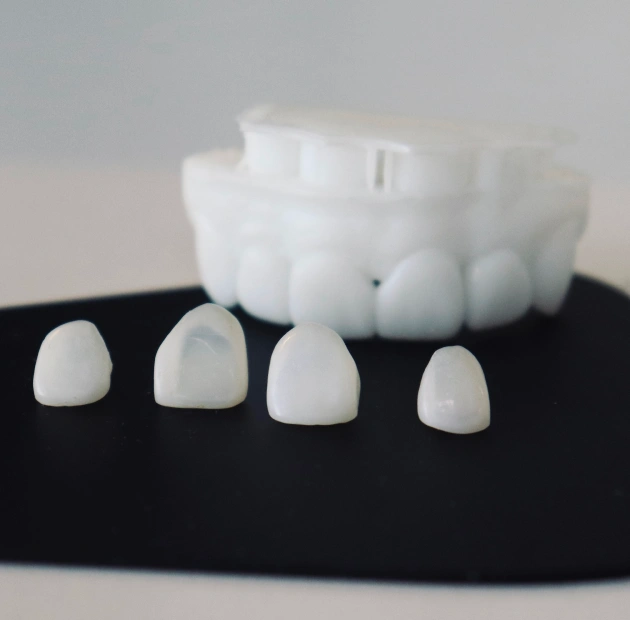
Ultra Thin Porcelain Applied With Minimal Tooth Reduction
Lumineers are a brand of contact lens thin porcelain veneer, made from a proprietary ceramic strong enough to be fabricated at roughly the thickness of a contact lens. That thinness is the entire point. Because so little material is being added to the front of the tooth, little or often no enamel needs to be removed to accommodate it.
For the right candidate, this changes the nature of the decision. Traditional veneers require permanent enamel reduction, meaning the teeth will always need coverage afterward. A no prep Lumineer case leaves the underlying tooth structure essentially intact, which makes the treatment reversible in principle rather than a lifelong commitment.

See If Lumineers Suit Your Smile
What Draws Patients to Lumineers
- Little or no enamel removal, preserving your natural tooth structure
- Usually no anesthetic needed, since there is minimal or no drilling
- Often no temporaries, because the teeth are not left prepared and exposed
- Reversible in principle, when no enamel has been reduced
- Minimal sensitivity, as the dentin is not exposed during preparation
- Stain resistant porcelain, holding its shade through years of coffee and tea
- A conservative entry point for patients hesitant about permanent cosmetic dentistry
Who Lumineers Work Well For, and Who They Do Not
Lumineers perform best on teeth that are already reasonably well aligned and reasonably well sized, where the goal is improving shade, evening out minor irregularities and closing small gaps. Patients with mildly discolored teeth, small chips, slightly uneven edges or minor spacing tend to get excellent results.
The limitation is a direct consequence of the thinness. Because material is being added to the front of the tooth without removing much, the tooth becomes marginally thicker. On teeth that are already prominent, crowded or rotated forward, that additional thickness can read as bulky rather than natural. Severe dark staining is also harder to mask through a very thin layer of porcelain, since some underlying color shows through.
Our team examines your teeth, reviews intraoral camera images with you, and gives you a direct answer about whether Lumineers or traditional veneers will produce the better result in your case. Recommending the more conservative option when it genuinely fits, and saying so when it does not, is the whole basis of an honest cosmetic consultation.
The Lumineer Process From Consultation to Placement
Treatment typically spans two appointments with no uncomfortable interim stage.
01
Evaluation and Planning
We assess your teeth and discuss your goals to determine if Lumineers are the right fit.

Prev
NEXT
02
Smile Design
Shade, shape, and overall look are planned in advance so you know what to expect.
Prev
NEXT
03
Digital Scan or Impressions
Accurate records of your teeth and bite are taken for precise fabrication.
Prev
NEXT
04
Custom Fabrication
Your Lumineers are crafted from ultra-thin ceramic to fit each tooth.
Prev
NEXT
05
Try-in and Approval
At your second visit, you preview the fit and appearance before final placement.
Prev
NEXT
06
Bonding and Finishing
The Lumineers are bonded securely, adjusted as needed, and polished for a natural, seamless result.
Prev
NEXT
Keeping Lumineers Looking New
Care is straightforward and largely mirrors natural teeth. Brush twice daily with a non abrasive toothpaste, floss every day with particular attention to the margins where porcelain meets tooth, and keep your recall visits so the edges can be checked and professionally polished.
Porcelain resists staining well, so coffee, tea and red wine affect Lumineers far less than they would affect bonded composite. Avoid biting hard objects, since very thin ceramic can chip under a concentrated point load. If you grind or clench, a night guard is not optional here. Grinding forces are the most common reason thin porcelain fails early.
How Long Lumineers Last and What Happens Next
Lumineers commonly serve well for a decade or more when they are properly bonded and properly maintained. Their longevity depends heavily on the same factors as any porcelain restoration: bite forces, grinding habits, gum health and hygiene at the margins.
If a Lumineer eventually chips or debonds, it can be replaced individually rather than redoing the whole case. And in a genuine no prep case where no enamel was removed, removal without needing replacement coverage remains possible, which is the flexibility that draws many patients to this option in the first place. We check every margin at recall visits so small issues get handled before they become larger ones.
A Brighter Smile Without Permanently Altering Your Teeth
If the permanence of traditional veneers has kept you from moving forward, Lumineers may be worth a conversation. Call 217-423-2400 or request an appointment.
Request an Appointment