3737 E State Route 36, Decatur, IL, 62521
A Protective Shield for the Grooves Where Cavities Begin
Molars and premolars are built with deep pits and fissures across their chewing surfaces, and in many people those grooves are narrower than a single toothbrush bristle. Food particles and bacteria settle inside and remain there regardless of how carefully the tooth is brushed. This is why the majority of cavities in school-aged children form on chewing surfaces rather than between the teeth.
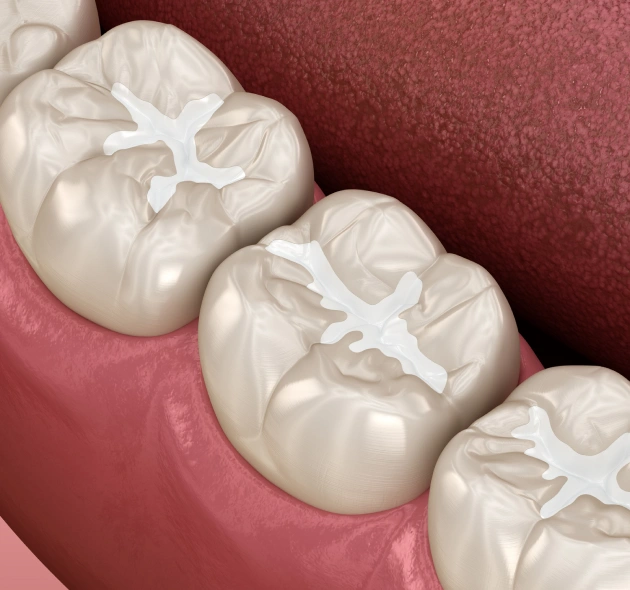
A dental sealant is a thin, tooth colored resin coating flowed into those grooves and hardened in place. Once sealed, the surface is smooth and cleanable, and there is nowhere for decay-causing bacteria to hide.

Ask About Sealants for Your Family
Why Sealants Are Worth Placing
- Strong cavity reduction. Sealants are one of the most researched preventive treatments in dentistry, with a well-documented record of preventing decay on treated surfaces.
- Completely painless. No drilling, no injection and no numbness.
Fast. Each tooth takes only a few minutes, and sealants are usually placed during a regular cleaning visit. - Cost-effective. Sealing a molar costs a small fraction of restoring it once decay sets in.
- Preserves natural tooth structure. A tooth that never needs a filling never begins the cycle of replacement restorations.
Who Should Consider Dental Sealants
- Children and teenagers. The ideal moment is shortly after a permanent molar erupts, around age six for first molars and around age twelve for second molars. Sealing promptly protects teeth through the years when cavity risk peaks and brushing habits are least dependable.
- Adults with unrestored molars. If the grooves are still intact and free of decay and existing fillings, adults are good candidates too, particularly anyone with a history of decay.
- Higher risk patients. Reduced saliva flow from medication, orthodontic appliances, deep anatomy, or frequent snacking all raise risk, and sealants offset a meaningful share of it.
Placing a Sealant Takes Less Time Than a Cleaning
The appointment is short and entirely comfortable, which is why it works so well for young patients.
01
Cleaning the Surface
The tooth is polished and any debris is removed from the grooves.

Prev
NEXT
02
Isolation and Drying
The tooth is kept dry, since moisture prevents proper bonding.
Prev
NEXT
03
Conditioning Gel
A mild etching gel is applied for a few seconds to create a slightly textured surface, then thoroughly rinsed away.
Prev
NEXT
04
Applying the Sealant
The liquid resin is flowed into the pits and fissures, where it settles into every groove.
Prev
NEXT
05
Curing
A specialized light hardens the material within seconds.
Prev
NEXT
06
Bite Check
The sealant is checked and adjusted so it does not interfere with how the teeth come together. Normal eating can resume immediately.
Prev
NEXT
How Long Sealants Last and How We Maintain Them
Sealants commonly hold up for several years, and many last considerably longer. They can chip or wear thin over time, particularly for patients who grind or regularly chew hard foods. We inspect them at every recall visit and can repair or replace one in a matter of minutes. Reapplying a sealant remains far simpler than treating the cavity it would otherwise have prevented.
Home Habits That Work Alongside Sealants
Sealants cover chewing surfaces only, so the sides of teeth, the contact points between teeth and the gum line still require daily attention. Twice daily brushing with fluoride toothpaste, daily flossing and limiting frequent sugary snacking and sipping give sealants the best possible support. Fluoride strengthens the smooth enamel surfaces that sealants do not cover, so the two protect different territory.
Insurance Coverage for Sealants
Many dental plans cover sealants for children up to a specified age, often with limits on which teeth qualify and how frequently they may be replaced. Adult coverage varies more widely between plans. Decatur Dental Care accepts most PPO plans, is a Delta Dental provider, and will verify your exact sealant benefits before treatment so there are no unexpected costs.
Protect Those Molars Before the First Cavity Appears
Sealants take minutes and can save years of dental work. Ask about them at your next visit or call 217-423-2400 to schedule.
Request Appointment