3737 E State Route 36, Decatur, IL, 62521

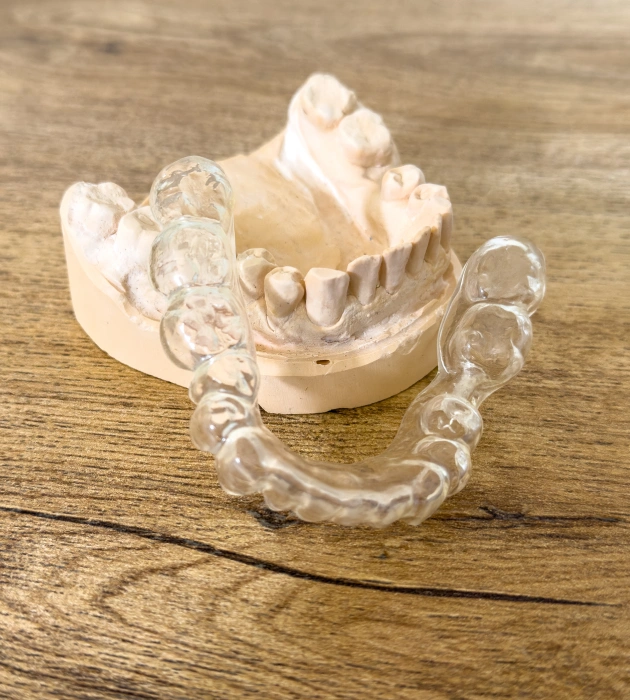
Correcting How Your Teeth Come Together
Occlusion is the term for how your upper and lower teeth meet. In a balanced bite, contact is distributed across many teeth simultaneously, and the jaw closes into a position where the joints seat comfortably. When that distribution is disrupted, one or two teeth make contact fractionally before the others, and everything else follows from that.
The consequences are cumulative rather than immediate. A tooth carrying more than its share of the load wears faster, becomes sensitive, may loosen slightly and often develops cracks over time. The jaw muscles compensate by guiding the jaw around the interference, and sustained compensation is what produces muscle fatigue, joint strain and headaches. Grinding frequently intensifies as the body attempts to eliminate the obstruction on its own.
Occlusal adjustment is the controlled reshaping of specific contact points to restore even distribution. The amount of enamel involved is measured in fractions of a millimeter, and the precision of where it is removed matters far more than the quantity.

Schedule a Bite Evaluation
Problems an Uneven Bite Creates
- Localized wear. Teeth taking excessive load flatten and wear through enamel considerably faster than the rest of the arch.
- Sensitivity without decay. Overloaded teeth become sensitive to cold and to biting pressure with nothing on the X-ray to explain it.
- Cracked teeth. Concentrated force is the mechanism behind most cracked tooth syndrome cases.
- Jaw muscle fatigue. Muscles working to steer around an interference stay active far longer than they should.
- Joint strain. A jaw that cannot close into its natural seated position loads the temporomandibular joints unevenly.
- Increased grinding. Interferences frequently trigger or worsen bruxism.
- Loose teeth and recession. Excessive occlusal force contributes to mobility, gum recession and localized bone loss.
- Failing restorations. Crowns and fillings that keep fracturing often sit on teeth carrying too much of the bite.
When a Bite Adjustment Is the Right Answer
Occlusal adjustment is appropriate when a specific, identifiable interference is producing symptoms. The clearest situations are a new crown, filling or bridge that feels high after placement, a tooth that has become sensitive to biting pressure without decay present, isolated wear that does not match the rest of your teeth, or teeth that have shifted following an extraction and now meet unevenly.
It is also valuable as a supporting treatment in TMJ care, where eliminating interferences reduces the muscular compensation contributing to joint symptoms, and following extensive restorative work where multiple new surfaces need to be harmonized with the existing bite.
There are situations where adjustment is not the right approach. Significant misalignment across the arch is an orthodontic problem, and reshaping teeth to compensate removes healthy enamel without correcting the underlying positioning. Skeletal discrepancies between the jaws need different management entirely. Because enamel does not regenerate, this is a treatment where conservative judgment matters, and we will tell you plainly when aligners, restorative treatment or a night guard would serve you better.
How a Bite Correction Is Performed
Adjustment is a diagnostic process as much as a treatment one, and it proceeds in small increments with verification at each stage.
01
Review Symptoms And Dental History
We begin by discussing when your bite problem started, whether it followed recent dental work, and which teeth feel uncomfortable and under what circumstances. This helps identify the source of the problem and guides the examination.

Prev
NEXT
02
Examine Your Teeth, Jaw Joints, And Muscles
Your teeth are checked for wear facets, chips, cracks, and mobility. We also examine the jaw joints and chewing muscles for tenderness. Intraoral camera images can help you see the wear patterns and areas we identify during the examination.
Prev
NEXT
03
Mark And Evaluate Tooth Contacts
Thin marking film is placed between your teeth as you bite down. The resulting colored marks show precisely where and how heavily your teeth contact. We then have you move your jaw from side to side and forward to identify interferences that may only appear during normal jaw movement.
Prev
NEXT
04
Analyze The Bite Pattern
The contact marks are carefully interpreted to distinguish the teeth that should be carrying the chewing load from contacts that may be interfering with a balanced closure. This step helps determine exactly which areas require adjustment.
Prev
NEXT
05
Precisely Reshape And Recheck Interfering Points
Interfering points are reduced using fine finishing instruments in very small increments. Typically, only enamel is adjusted, and anesthetic is not needed. The teeth are then remarked and checked again. This process is repeated until the contacts are distributed more evenly and the bite feels balanced.
Prev
NEXT
06
Polish And Reassess The Final Bite
Once the adjustment is complete, the treated surfaces are polished smooth. We confirm that your bite feels comfortable and balanced before finishing. A follow-up assessment can also allow for further refinement after you have had time to chew normally and adapt to the adjusted bite.
Prev
NEXT
What the Adjustment Feels Like and What Follows
The procedure itself is comfortable. Reshaping is confined to enamel, which contains no nerve endings, so most patients need no anesthetic and describe the sensation as similar to a polishing appointment.
Afterward, the bite usually feels different immediately, and for many patients a tooth that has been uncomfortable to bite on stops hurting the same day. Some patients notice their teeth feel slightly unfamiliar for a few days as the muscles adapt to a new closing pattern, which resolves as the pattern becomes established.
A small number of cases need a second short visit. Muscles that have been compensating for a long time relax over the following days, which can subtly change how the jaw closes and reveal a remaining contact that was masked before. This is expected rather than a sign the first adjustment failed, and refining it takes only minutes.
Insurance and Payment for Occlusal Adjustment
Coverage varies meaningfully between plans. Limited adjustment performed alongside a new restoration is often included as part of that procedure. More extensive adjustment is sometimes covered under basic or major services, and sometimes classified under TMJ treatment, which certain policies exclude by name. Where the adjustment is part of managing a diagnosed temporomandibular disorder, medical coverage occasionally applies.
Decatur Dental Care accepts most PPO plans, is a Delta Dental provider, and files claims for our patients. We verify how your specific plan handles occlusal adjustment before treatment and provide a written itemized estimate of coverage and your portion. CareCredit financing is available, along with cash, check, Visa, Mastercard and Discover.
A Tooth That Hurts When You Bite Is Telling You Something
Uneven bite forces do cumulative damage, and the teeth carrying the excess load are the ones that crack first. Call 217-423-2400 or request an appointment for a bite evaluation.
Request Appointment