3737 E State Route 36, Decatur, IL, 62521
Restoring the Healthy Foundation of Your Smile
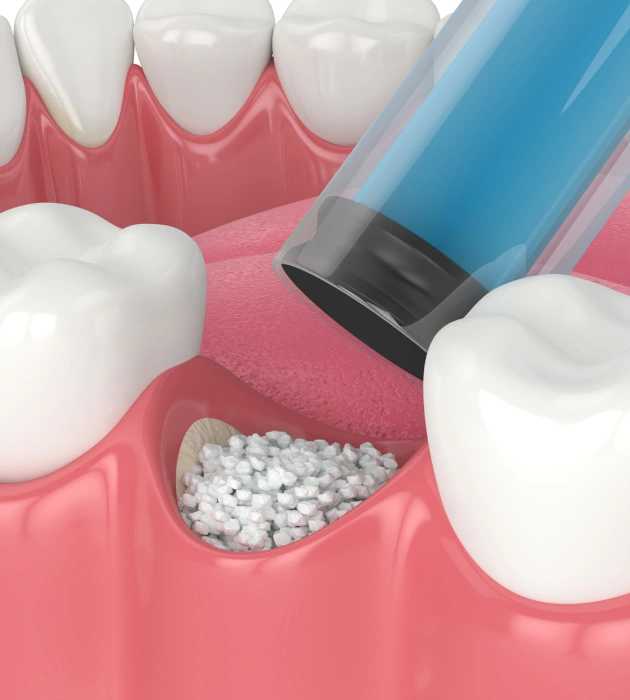
Dental bone grafting is a procedure that adds volume to areas of the jaw where bone has been lost or has never been sufficient. Graft material is placed into the deficient site, where it functions as a scaffold. Over the following months your own bone cells migrate into that scaffold, gradually replacing it with living, vascularized bone capable of supporting a dental implant.
The reason grafting comes up so often is straightforward. The jawbone that surrounds a tooth root exists specifically to support that root, and when the tooth is removed the bone loses its purpose. Resorption begins within weeks and is most rapid during the first several months, continuing slowly for years afterward. A site that had ample bone at the time of extraction may have significantly less a year later.
Grafting either prevents that loss from occurring or restores what has already been lost, which is what makes implant treatment possible in situations where it would otherwise be ruled out.

Discuss Grafting Options With Us
When Bone Grafting Becomes Necessary
- At the time of extraction Placing graft material directly into the socket preserves ridge height and width for a future implant.
- Before implant placement. Where a tooth has been missing for years and the ridge has already resorbed.
- After periodontal bone loss. Advanced gum disease destroys the bone supporting teeth, and grafting can regenerate some of it.
- Sinus proximity in the upper jaw. Upper back teeth sit close to the maxillary sinus, and bone height is frequently inadequate for implants there.
- Following trauma. Injury that has damaged the jawbone or resulted in tooth loss with bone fracture.
- Ridge defects. Areas that are too narrow or too shallow to accommodate an implant of appropriate dimensions.
- Long term denture wear. Decades without root stimulation produces substantial ridge resorption, sometimes limiting denture stability itself.
Understanding Graft Materials
Patients frequently ask what is actually being placed, and it is a reasonable question. Several materials are used in dentistry, each thoroughly studied and each suited to particular situations.
Autograft material comes from your own body, typically harvested from another site in the jaw. Allograft material is processed human donor bone from a tissue bank, screened and sterilized to established medical standards. Xenograft material derives from an animal source, most commonly bovine, processed to remove all organic components and leave only the mineral scaffold. Synthetic materials are manufactured from biocompatible minerals that mimic the structure of natural bone.
In every case, the graft functions as a framework rather than remaining permanently as foreign material. Your own cells populate it and convert the site into living bone over the following months. We explain which material suits your specific case and why during treatment planning, and you are welcome to ask as many questions about it as you want.
How a Grafting Procedure Is Carried Out
The specifics vary by graft type, though the underlying sequence is consistent.
01
Imaging and Site Assessment
Panorex panoramic imaging evaluates bone height, ridge contour, sinus position, and nerve location to determine the type of graft required.

Prev
NEXT
02
Treatment Planning
We determine how much bone volume is needed, select the appropriate grafting material and technique, and coordinate the timeline with future implant placement.
Prev
NEXT
03
Anesthesia and Site Access
The area is fully numbed with local anesthesia, with nitrous oxide available if desired. A small incision is made to expose and assess the deficient bone.
Prev
NEXT
04
Preparing the Recipient Bed
The site is cleaned and prepared to ensure the graft material contacts healthy bone, supporting proper integration.
Prev
NEXT
05
Placing the Graft and Membrane
The graft material is positioned and shaped to the needed contour, and a protective membrane is often placed to support bone regeneration.
Prev
NEXT
06
Closing the site
The area is sutured to protect the graft during healing, and you’ll receive detailed aftercare instructions.
Prev
NEXT
07
Sealing the canal system
The canals are filled with a biocompatible material that fills the space entirely and prevents bacteria from recolonizing.
Prev
NEXT
08
Restoring the Access Opening
The opening is sealed, and the tooth is prepared for its final restoration.
Prev
NEXT
Why Grafting Early Costs Less Than Grafting Later
This is worth stating plainly, because the sequencing decision usually arrives at an extraction appointment when patients are focused on the tooth rather than the year ahead.
Socket preservation performed at the time of extraction is the simplest, quickest and least expensive form of grafting available. It maintains what is already there rather than rebuilding what has been lost. Ridge augmentation performed three years later to correct the same site requires more material, more healing time and more expense, and the final result is generally less predictable than preservation would have been.
The same applies to the upper jaw. A socket grafted at extraction often avoids the need for a sinus lift entirely, while a site left to resorb frequently requires one. We raise this before extractions specifically so the decision is made with full information rather than revisited later.
Insurance Coverage and Payment for Bone Grafting
Coverage for grafting varies considerably. Some dental plans include bone grafts under oral surgery benefits, particularly when performed alongside an extraction or as part of periodontal treatment. Others classify grafting as part of implant treatment and apply whatever implant exclusions the policy carries. Membranes and graft material are sometimes billed as separate line items.
Because grafting is usually one phase of a longer treatment plan involving extraction, implant placement and a final restoration, the phases frequently span different benefit years, and deliberate sequencing can capture more than one annual maximum.
Decatur Dental Care accepts most PPO plans, is a Delta Dental provider, and files claims for our patients. We verify how your plan handles grafting specifically and provide a written itemized estimate covering each phase before treatment begins. CareCredit financing suits extended treatment timelines well, and we accept cash, check, Visa, Mastercard and Discover.
Insurance Coverage and Payment for Bone Grafting
Coverage for grafting varies considerably. Some dental plans include bone grafts under oral surgery benefits, particularly when performed alongside an extraction or as part of periodontal treatment. Others classify grafting as part of implant treatment and apply whatever implant exclusions the policy carries. Membranes and graft material are sometimes billed as separate line items.
Because grafting is usually one phase of a longer treatment plan involving extraction, implant placement and a final restoration, the phases frequently span different benefit years, and deliberate sequencing can capture more than one annual maximum.
Decatur Dental Care accepts most PPO plans, is a Delta Dental provider, and files claims for our patients. We verify how your plan handles grafting specifically and provide a written itemized estimate covering each phase before treatment begins. CareCredit financing suits extended treatment timelines well, and we accept cash, check, Visa, Mastercard and Discover.
If an Extraction Is Coming, Plan the Site Before the Tooth Comes Out
Preserving bone at the time of extraction is far simpler than rebuilding it later. Call 217-423-2400 or request an appointment to discuss whether grafting belongs in your treatment plan.
Request Appointment