3737 E State Route 36, Decatur, IL, 62521

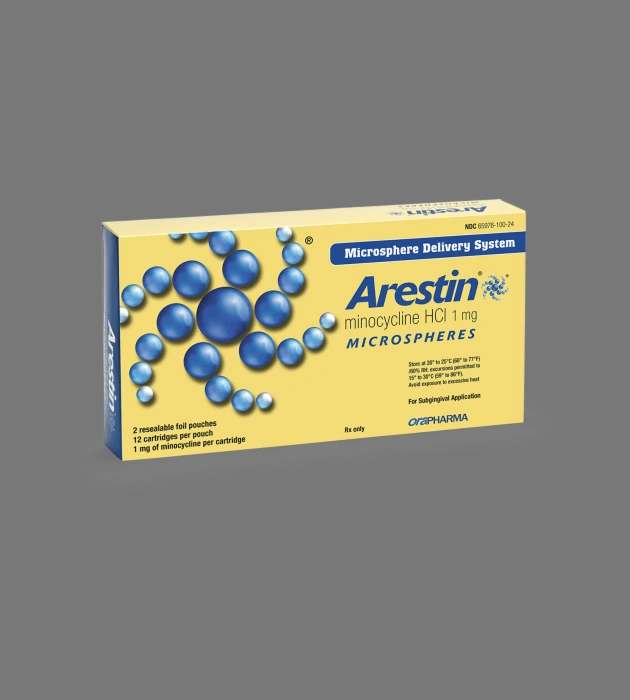
Targeted Treatment for Deep Gum Pockets
Arestin is a locally administered antibiotic used alongside scaling and root planing to treat periodontal disease. The active ingredient is minocycline, delivered as microspheres barely visible, placed directly into the periodontal pocket immediately after the root surface has been cleaned.
What makes this delivery method effective is where the medication ends up. Once placed, the microspheres adhere within the pocket and release minocycline gradually over days, maintaining an antibacterial concentration at the exact site of infection. That concentration is substantially higher than what an oral antibiotic could produce in the same location, because a systemic pill has to circulate through your entire body to deliver a fraction of its dose to gum tissue.
Arestin is not a replacement for mechanical cleaning. Scaling and root planing removes the calculus and biofilm physically, and Arestin addresses the bacteria that remain in sites where instrumentation alone may not fully resolve the infection.

Ask About Arestin at Your Next Visit
Why Targeted Delivery Works Better in Deep Pockets
- Concentrated where it matters. The medication acts at the infection site rather than being diluted throughout your bloodstream.
- Sustained release. Minocycline is released gradually over days rather than in a single dose that clears quickly.
- Reaches sites instruments struggle with. Deep pockets, furcations between roots and irregular root anatomy all present physical limits to instrumentation.
- No systemic antibiotic course. Avoids the side effects, drug interactions and digestive disruption associated with oral antibiotics.
- Measurably improved outcomes. Adding Arestin to scaling and root planing produces greater pocket depth reduction than mechanical cleaning alone.
- No activation or removal required. The microspheres bioresorb on their own, so there is nothing to take out afterward.
- Applied in seconds. Placement adds almost no time to an appointment you are already having.
Which Patients and Which Sites Benefit Most
Arestin is used selectively rather than placed in every pocket. It is most valuable in sites with deeper pocket depths that persist after scaling and root planing, in areas that continue bleeding on probing at reevaluation, and in furcation areas where the anatomy between the roots of molars makes complete instrumentation genuinely difficult.
It is also useful for patients whose risk profile makes periodontal disease harder to control, including smokers, patients managing diabetes and those with a history of recurrent periodontal infection. In these cases the additional antibacterial effect can meaningfully improve results in sites that would otherwise be borderline.
Arestin is not appropriate for everyone. Patients with a known allergy to minocycline or other tetracycline class antibiotics cannot receive it, and it is generally avoided during pregnancy and nursing and in young children whose teeth are still developing. We review your full medical history and current medications before recommending it.
How Arestin Is Placed
Placement occurs during your scaling and root planing appointment, immediately after the treated area has been cleaned.
01
Site Selection
Using your periodontal chart, we identify which pockets require treatment based on depth, bleeding, and anatomy.

Prev
NEXT
02
Deep Cleaning
The root surfaces are thoroughly scaled and planed first, ensuring the pocket is free of calculus and biofilm before antibiotic placement.
Prev
NEXT
03
Site Preparation
The area is gently dried and isolated so the medication can adhere properly within the pocket.
Prev
NEXT
04
Antibiotic Placement
Microspheres are delivered directly to the base of the pocket using a small applicator, with no needles involved.
Prev
NEXT
05
Placement Verification And Repetition
We confirm proper depth and placement, then repeat the process for each targeted site during the visit.
Prev
NEXT
06
Aftercare Instructions
You receive clear guidance on what to avoid over the next several days to keep the medication in place and effective.
Prev
NEXT
What Arestin Does and Does Not Change
It is worth being clear about the role this treatment plays, because the name and the delivery method sometimes create an impression of a standalone cure.
Arestin improves the outcome of periodontal therapy in specific sites. It does not replace scaling and root planing, it does not reverse bone that has already been lost, and it does not eliminate the need for periodontal maintenance at three to four month intervals afterward. Placing antibiotic into an unclean pocket accomplishes very little, which is why mechanical debridement always precedes it.
What it does accomplish is meaningful. In pockets that are deep, anatomically awkward or persistently inflamed, the additional antibacterial effect frequently produces the pocket depth reduction that scaling alone would not have achieved, which can be the difference between a site stabilizing and a site requiring surgical intervention.
Your reevaluation appointment four to six weeks after treatment is where this gets assessed. Pockets are remeasured, bleeding sites recorded again, and the results compared against your pretreatment chart. That comparison tells us whether treated sites responded and whether any require further attention.
Insurance Coverage for Localized Antibiotic Therapy
Coverage for Arestin varies considerably between plans. Some dental policies cover localized antibiotic delivery as an adjunct to periodontal treatment, frequently with limits on the number of sites treated per visit or per year. Others exclude it entirely and classify it as an elective addition to scaling and root planing. Billing is generally per tooth site, so the total depends on how many pockets are treated.
Decatur Dental Care accepts most PPO plans, is a Delta Dental provider, and files claims for our patients. We verify whether your specific plan covers localized antibiotic therapy and how many sites it allows, then provide a written itemized estimate before treatment so the cost is clear in advance rather than appearing on a statement afterward. CareCredit financing is available for larger periodontal cases, and we accept cash, check, Visa, Mastercard and Discover.
Deep Pockets That Keep Bleeding Need More than a Cleaning
If periodontal treatment has not fully resolved certain sites, targeted antibiotic therapy may close the gap. Call 217-423-2400 or request an appointment for a periodontal evaluation.
Request Appointment